
.svg)
.svg)

What’s the short paragraph that defines your company wherever people encounter it, from a press release to your website or media kit? That’s your company boilerplate.
It began as a standard paragraph at the end of press releases, but today it plays a much larger role. The modern boilerplate works as a concise, story-led statement that links your company’s purpose and values across all communication channels. It also helps audiences understand who you are and what you represent.
When someone discovers your company online or in the news, your boilerplate should express your identity in a way that feels authentic and consistent.
This guide will show you how to write a boilerplate that reflects your brand voice and helps your audience recognize your company across every channel. It also includes a checklist and examples to help you put everything into practice.
What Is a Boilerplate Statement?
A company boilerplate statement is a paragraph of text at the bottom of a press release. Many organizations now also include the same text on their websites or in media kits to keep their messaging consistent. Companies also add a boilerplate to profiles on platforms like LinkedIn or Crunchbase because those pages often shape first impressions and help journalists and potential partners understand the brand at a glance.
A strong boilerplate might mention when your business was founded and where it operates. It can describe your primary focus or market, followed by a fact that builds credibility. The paragraph usually closes with a way for readers to contact your team or connect through social media.
For example, in a press release from Sony AI, a subsidiary of Sony Group Corporation, the section titled “About Sony AI” serves as the company's boilerplate. The same text appears in other Sony releases, showing how a single, consistent description strengthens brand communication across platforms.
To write a strong boilerplate, you need to know exactly what your company stands for and say it clearly and concisely. The right one captures what defines your company without wasting a single word.
Why Do Companies Need a Boilerplate?
It's a simple enough concept, but a truly impactful company boilerplate makes all the difference to how a press release is received.
Remember that a press release is an opportunity to get just a few moments of someone's time to deliver a quick message. You don't have long to make a strong impression. Now, imagine that the introduction and body of your press release is perfect, but your boilerplate isn't written well.
Since your boilerplate is your chance to tell readers who you are, an unclear or incomplete boilerplate ruins the impact of the rest of your press release and undermines brand awareness. Not only will it be hard to discern who you are and what you do, but readers will also come away with a negative impression.
Bad company boilerplates are press release killers. After all, a message can't be effective if the receiver doesn't know who is sending it! That's why your boilerplate copy is so important.
Download Our Free Company Boilerplate Template

Struggling to write a compelling but succinct boilerplate for your business? Use our simple company boilerplate template as a starting point. You can save or download a copy of the template to your computer and customize it Mad Libs style.
Our template also includes optional "detail" sentences for including additional details about your company. Download it here to use for your next press release!
When and Where To Use a Company Boilerplate
A company boilerplate isn’t limited to press releases. It’s a flexible tool that helps your organization present a consistent brand identity across websites, media kits, social profiles, and other public-facing materials.
- Press releases: Add the boilerplate at the end of every announcement to reinforce who’s speaking and give journalists quick, reliable context.
- Media kits and partnership decks: Use it to provide collaborators with a short overview of your organization’s scope, mission, and focus areas.
- Company About page: Feature an adapted version that fits your website’s tone and retains core details such as your founding date, area of expertise, and long-term vision.
- Investor materials or proposals: Include a concise boilerplate to show professionalism and keep messaging unified across all documents.
- Social and digital profiles: A shortened version can serve as a profile bio or meta description, helping your brand stay visible and consistent in search results. You can also add a tailored version of your boilerplate to your company’s blog to reinforce messaging across all content touchpoints.
A well-written boilerplate reinforces your credibility and helps people quickly understand who you are and what you offer. The language should stay clear and consistent, reinforcing your brand every time it’s seen.
What Should a Company Boilerplate Include?
Journalists are constantly flooded with business-related emails, and press releases are just one more item in the mix. To stand out, your pitch needs a distinct edge right from the start. Companies that send press releases all start sounding the same in journalists' minds. A truly great boilerplate will spark interest and trust among the journalists you're trying to capture. With so many companies competing for the same eyes, your boilerplate is what gets your company to the top of the pile.
So, what should a company boilerplate include to accomplish this?
A Unique, Compelling Statement
Your company boilerplate should describe your company's origins and achievements. Write it in a way that demonstrates how great your company is at what it does. It should strengthen your press releases by showing why your company matters and what it brings to the table.
If your company stands out, journalists are more likely to pay attention and publish your release. A great boilerplate also makes it easier for journalists to do their jobs. These journalists cover companies like yours every day, so giving them a favorable impression is a huge win for your public relations efforts.
Mission Statement
Including a short version of your mission statement helps readers immediately understand what your business stands for and why it exists. It adds context to the facts and shows that your company is driven by a clear purpose — not just what you do, but why it matters.
When you write your boilerplate, open with a distilled version of your mission statement. Keep it brief—one or two sentences at most—and use language that feels natural to your brand. Avoid vague claims or overused phrases about innovation or leadership. Instead, focus on what drives your company to act. Highlight your values by focusing on what your company actually does instead of relying on generic buzzwords.
By leading with your mission, you set the tone for everything that follows. The rest of your boilerplate can then build on that foundation, explaining what your company does and how it contributes to its field.
Core Values
Core values show what your company believes in and how it operates. They go beyond describing what you sell or make and instead highlight the principles that shape your decisions. Including them in your boilerplate helps readers understand your company’s character and how it stands apart from others in your field.
Choose two or three values that best reflect your organization’s priorities. These might relate to how you treat customers, how you approach your work, or how you contribute to your industry. Keep your language straightforward. Avoid lofty phrasing or empty promises, and focus on values that genuinely guide your company’s actions.
When you include core values in your boilerplate, you give your brand a clear voice that carries across every channel. Because the boilerplate appears in press releases, web copy, and marketing materials, it keeps your values visible each time someone reads about your business.
Strong, well-defined values help readers understand who you are and why your work matters.
Boilerplate Positioning Statement
A boilerplate's positioning statement is a one-sentence statement that shows the reader why your company is newsworthy. It should portray what makes your company unique and significant.
For example, is your company the first national brand to offer farm-to-table meal kits for vegans and vegetarians? Are you the largest provider of saddles and riding equipment in the state of Texas?
These are the kinds of things you should include in your positioning statement. Make this the first or second sentence of your boilerplate.
Use the positioning statement to highlight one of your company’s most notable accomplishments. You want it to tell the reader that your company is one that deserves to be written about!
Other Elements To Include
The purpose of a press release and company boilerplate is twofold: you're trying to appeal to journalists, but you're also trying to market your company's offerings to readers. For that reason, when you are crafting your company boilerplate, you should keep your marketing goals in mind. Think of the products you most want to promote and be known for and include them in your boilerplate.
On that same note, a big part of marketing is knowing what not to talk about. Your boilerplate marketing concept is no different. The following list provides a summary of basic information and whether or not you'll want to include it.
- Founding Date & Founders: If the founding date of the company was decades ago, include it in the boilerplate. If you're a brand new company, you probably don't need to include this info. If you have famous founders, investors, or other people involved in your company, mention them as well, but only if they have recognizable names.
- Size & Location: Mention your company's size only if it's substantial—think 300 to 500 employees or more. Location often isn't important, but if your company has a history that is tied in with its founding location, or you are a chain with many locations, mention it!
- Revenue & Funding: If you've raised large amounts of outside money or have very substantial revenues, mention it, especially if the money came from a well-known firm or investor.
- Customers/Users: If your company has an impressive number of customers, say something about it. You might be able to get creative here—for example, if your company is a social media site for plant lovers, maybe you can mention that your users have planted 1.1 million seeds since you launched.
- Other Info: Include any other info that you think will make your company feel relevant and successful, but keep it brief. If your company is publicly traded, you'll want to include the stock ticker symbol as well.
Tips for Writing a Strong Boilerplate
Once you've written your boilerplate, use this quick-reference checklist to make sure it hits all the main marks. Once finalized, you can use it as a boilerplate example template and just update its relevant details whenever new developments occur that are worth including.
- Brevity: Is your boilerplate restricted to 1-2 brief paragraphs?
- Information & Relevance: Do you include key information about your company, portrayed in an energetic and positive light? Do you make note of aspects like what industry your company is in, your growth, and your global reach? This kind of information shows journalists that your company is relevant and worth writing about.
- Honors & Awards: If your company has received awards lately, are they mentioned? Have you hit any major milestones lately? How do you portray your company as one that works for the social or economic good?
- Clarity: Is your boilerplate easy for the average person to read and understand? If not, cut out the technical jargon and replace it with common language.
- Specific Language & Examples: Do you back up claims in your boilerplate with specific examples and data when applicable? Make sure you use specific language rather than generalities. For example, if your company produces products for vegans, don't simply say you produce "food products."
- SEO & CTA: Do you use relevant keywords in your boilerplate and prompt readers to visit your website, blog, and social media pages with links?
Company Boilerplate Examples
If you're like most people, you learn best when you are able to review some examples. To that end, the following are some sample boilerplates from three different companies. Take a look at these company boilerplate examples to see how it's done. After each example, we'll outline what makes these examples effective.
Company Boilerplate Example 1: The Hershey Company
For our first press release boilerplate example, we'll start with a company boilerplate used by Hershey, one of the most recognizable candy brands in the US:
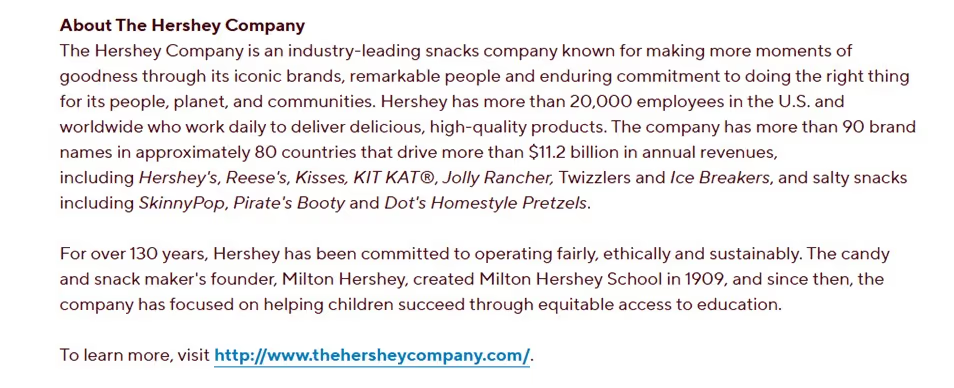
In this press release, notice how Hershey points out how long they've been in business, making note of a major milestone. But more importantly, the way they summarize their company focuses on being extremely positive and highlighting the social benefits of Hershey's work. You'll also notice they included information showcasing that they have dozens of brands and employ thousands of workers, highlighting the success of the company.
Interestingly, this boilerplate has two positioning statements: one right at the beginning and one right at the end. The first sentence is the primary positioning statement, and the closing sentence concludes by giving more detail about the scope of the company's charitable efforts.
Company Boilerplate Example 2: AMD
For another boilerplate press release example, take a look at boilerplate from AMD. Also known as Advanced Micro Devices, they're one of the world's largest manufacturers of graphics cards and other technologies. Here is the company's LinkedIn boilerplate:
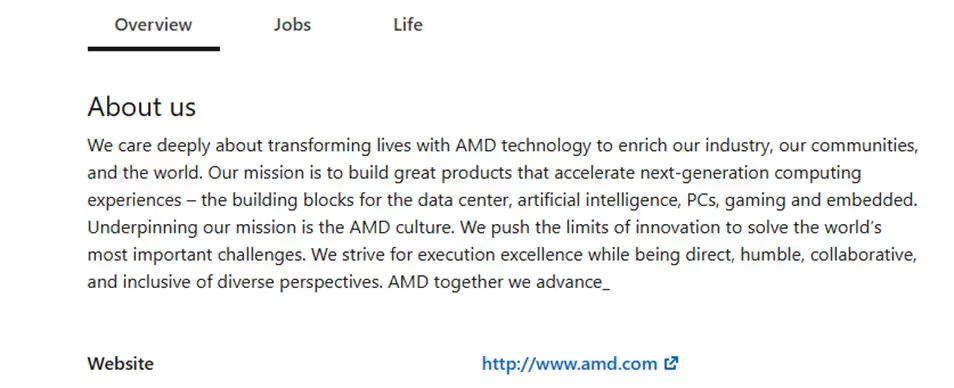
In this boilerplate, AMD emphasizes that they reach the needs not only of individual consumers, but large corporations and research facilities as well. This portrays the "big picture" of a world-changing company, going beyond one that simply offers retail graphics cards for gamers. This boilerplate is quite brief, but it opens with a positioning statement and then goes into more detail regarding the achievements and global impact of the company.
Also note the positioning statement. AMD’s boilerplate highlights how its technology powers a wide range of devices and digital experiences. More than just a technology provider, they show that they are a digital infrastructure company as well. This highlights the company's broad reach.
Company Boilerplate Example 3: Amgen
For another boilerplate language example, take a look at Amgen. They are a biotechnology company that announced a partnership with Harvard University. Here is Amgen's company boilerplate, taken from a press release on Harvard's website:
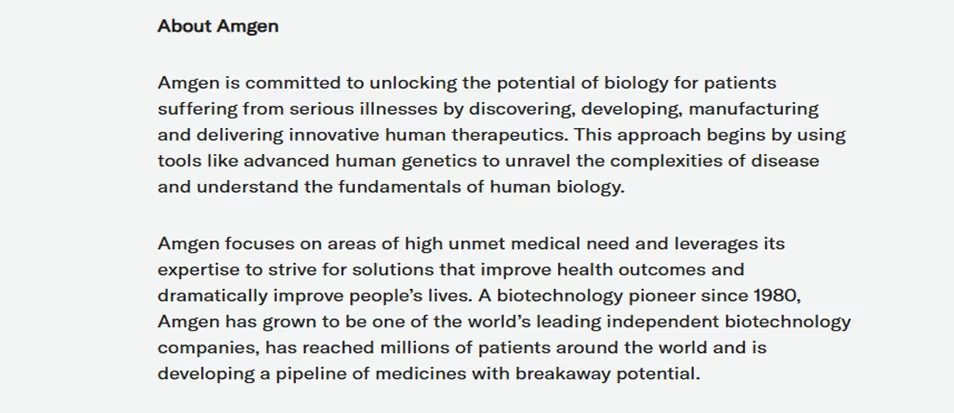
You don't want your boilerplate to be too short and not say enough. But you also don't want it to be too long and become hard to read. Amgen's boilerplate is right on the cusp of being too long. With just one more paragraph, it would be too wordy. While the Hershey and AMD boilerplates are a bit more succinct, Amgen's still stays within an ideal range.
Amgen is a scientific company that is involved in lots of technical research and product development, but the boilerplate uses easy-to-read words without resorting to advanced technical jargon.
This is an important point. You want your boilerplate, and press release in general, to be accessible to a general audience, avoiding overly technical words. Assume that no one reading will be an expert in your industry, and they won't know any technical terms.
Final Thoughts
Strong boilerplate captures your purpose and reflects your values. It gives readers a clear sense of who you are and why your work matters, all within a few lines. When the writing is consistent and true to your brand voice, it becomes one of the most dependable tools in your communication strategy.
Your company has a brand story worth sharing. Make sure every audience — from journalists to customers — recognizes it right away. If you need help crafting that story, explore our blog writing services to work with expert writers who can bring your brand to life.


