This has been generated by AI and optimized by a human.
[00:00:00] Mike Leonhard: I would highly, highly recommend that you take a hard look at your team and you make sure that, do you have team members who are willing to change that are open to change, and even further want to drive that change? That to me is the biggest risk is if you stay stagnant and you don't move, and you rely on outdated tactics.
[00:00:18] Mike Leonhard: In this insanely fast evolution we're seeing right now.
[00:00:25] Nicole MacLean: I'm Nicole MacLean and this is Content Matters. Created in partnership with Share Your Genius. This show is your digital partner for filtering the trends and focusing on the content that matters most, creating connection that drives results. Let's cut through the marketing chaos together.
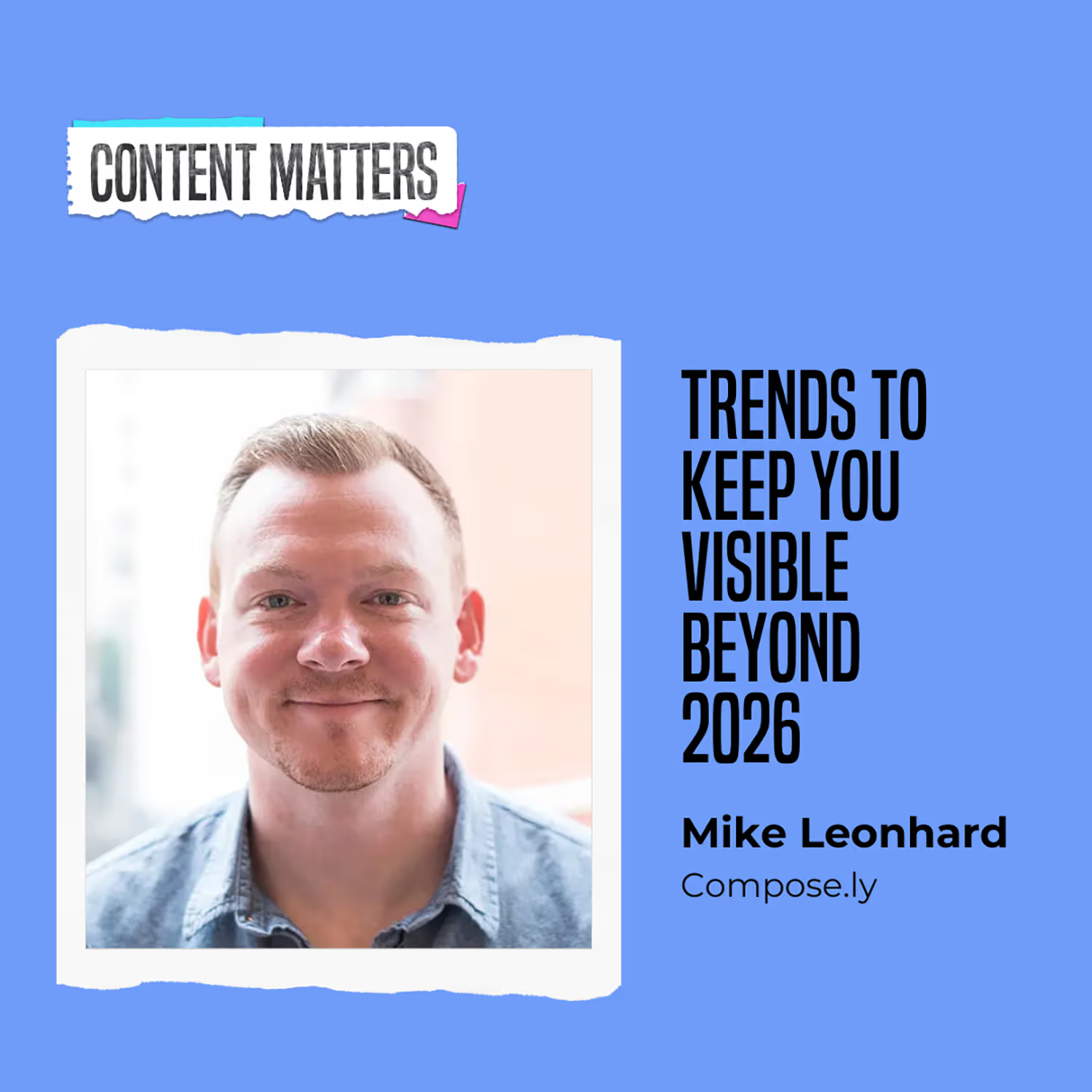
[00:00:45] Nicole MacLean: Welcome to a special edition of Content Matters. As we close out the year, we're answering the question on everyone's minds. What are the most important things that I can do to keep my brand visible and thriving as we head into 2026? Joining me to help answer that question is our very own founder and CEO Mike Leonhard.
[00:01:04] Nicole MacLean: Now, as always, Mike is joining to give us the executive perspective and give us some insights that can help us stay resilient in what can only be described as a rollercoaster of a season. Of course, we're talking about the impact of your favorite robot and mine, and specifically the role of content in AI and traditional channels.
[00:01:24] Nicole MacLean: AI's role in shaping marketing strategies. Both workflow and new channels and what you need to be thinking about in order to stay visible. This should be a good one. And our goal is that you walk away with at least one idea or tactic that you can implement in your 2026 strategy. So without further ado, let's get started.
[00:01:43] Nicole MacLean: Alright. Hello everyone. Happy Wednesday. We're really excited to have you. Of course, we're joined by our one and only CEO and founder Mike Leonard.
[00:01:52] Mike Leonhard: Thank you Nicole. It's great to be here.
[00:01:54] Nicole MacLean: I'm really excited for today's conversation 'cause we're gonna be talking about predictions. I know a lot of you are currently trying to do planning and, and give their CEOs, you know, the plan that's gonna dominate, you know, performance next quarter.
[00:02:08] Nicole MacLean: So that's really the goal of today is just to kind of share some trends we're seeing in the market and hopefully give you some ideas and things to think about as you're building your strategies. Clicks are becoming more expensive. AI is changing the game. Last week, we had one of the most engaged sessions I have ever experienced in my long plus as a marketer.
[00:02:28] Nicole MacLean: So many great questions on Reddit. And how to use it, how to take advantage of it, how to logistically like manage that, but how to also work that into strategy. And then today we are going, like I said, to speak to how all of those things can work into your strategy as well as some other things that we recommend.
[00:02:45] Nicole MacLean: So everyone loves to throw around like X thing is dead. Do you think that any marketing channel really is dead? Like let's just kind of start there. Is there anything that just shouldn't really be thought of in a 2026 strategy?
[00:03:00] Mike Leonhard: I think in terms of digital market, I'm just going to answer this in terms of sort of digital marketing.
[00:03:05] Mike Leonhard: I'm tired of people, you know, keep throwing out that this is dead or that is dead. I mean, nothing to me is dead. Everything is evolving, everything is changing. I mean, there's no doubt about that. I mean, not only are the tactics changing, but the landscape is changing, right? We're standing on a rapidly changing landscape right now, and you know that scene.
[00:03:26] Mike Leonhard: Search engines first and foremost with a IO and all these other impacts being felt for months and and years now. But I feel like that pace of change is only gonna continue to increase. We're gonna see. Everything evolving from email to social, to search to paid, everything is going to change. So to say anything is dead, I just think is not accurate.
[00:03:50] Mike Leonhard: I mean, maybe you can consider it dead, and as far as it's just, it's changed so dramatically from where it was 2, 3, 4 years ago. But I don't think any of these channels are you. You could say that they're officially dead. That's my opinion.
[00:04:04] Nicole MacLean: Well, even non-digital channels I think are making a resurgence.
[00:04:08] Nicole MacLean: You know, I think people said that COVID meant events were dead, and now there's, I think, a bigger resurgence. 'cause everyone misses being in person direct mail. It cuts through the noise. It's a little harder now, don't get me wrong, but I feel like I've seen a resurgence of out of home platforms to manage out of home ads, which, who would think that we still have, you know, billboards being a, a.
[00:04:30] Nicole MacLean: Part of today's ecosystem of marketing. So I do think, I think that evolution mindset versus it's dead and we're just, you know, you can just take it off of the, the marketing mix is, is a good point.
[00:04:44] Mike Leonhard: Yeah, totally agree.
[00:04:45] Nicole MacLean: So to that, as you think about 2026, both from your perspective and also what we've been hearing from clients, what do you think are some of the channels, tactics, strategies?
[00:04:58] Nicole MacLean: That we should be focusing on or the trends of where we think people are going to kind of still manage performance in this evolution of channels.
[00:05:08] Mike Leonhard: I think at Compose.ly, as you probably know better than anyone, we spent a lot of time more recently investigating. Not only just how the landscape is changing, like I said before, but the different tools and the different methods of being able to accomplish what used to be maybe very manual in a much more efficient way now.
[00:05:30] Mike Leonhard: So one of the things that I. Foresee is that companies that were just focused on doing one type of marketing, like they're all in on one thing, whether it be social or paid advertising, you know, organic, social, paid advertising, SEO, that isn't gonna cut it anymore. I think being able to be truly omnichannel with your marketing strategy is gonna become more accessible to.
[00:05:54] Mike Leonhard: All different sizes and shapes of companies that maybe previously it just wasn't feasible. Maybe you couldn't hire the people or you couldn't afford the tools that were needed, that were really, really expensive to be able to. Do the, you know, a BM marketing or certain types of marketing that are really intensive, either manpower intensive or technology and, you know, tech intensive in terms of cost.
[00:06:20] Mike Leonhard: I think those things are changing and you're hearing it more and more, but you're gonna be able to do more with. With less thanks to a lot of the AI tools that are becoming available and will continue to become available, that will help you to market your brand better and help you to participate in more channels than maybe you were able to before.
[00:06:39] Mike Leonhard: And so I think you're hearing a lot about this, but you could take someone who's a strategist and they're gonna be able to use tools to be able to execute on a much grander scale than they used to, because they would have to hire an entire team of people to help execute on those strategies. So I do see that as being something that will have quite an impact to a variety of different companies of all different sizes and industries.
[00:07:02] Mike Leonhard: And it'll be interesting to see how that changes. And that's just something we're living through right now as we constantly analyze sort of our tech stack and what are the tools that we use to service our customers. So how do we make sure we're doing it in the most effective, fastest, efficient, and high quality way that we can.
[00:07:21] Nicole MacLean: Yeah, I think that holistic piece is critical. I've seen this a bit over the last few years, and I think the. Adoption of AI has just quickened the movement to this, but I think marketers and marketing in general has gone through a really interesting shift over the last 20, 30 years. You have the core of marketing, which were campaigns and brands.
[00:07:46] Nicole MacLean: You know, you think back to like Mad Men, and that's what people think of marketing. That's where marketing, I think, gets an arts and crafts title. Sometimes it's like, well, that's just what marketing does. But campaigns were campaigns. It was. Holistic, it was, how are we gonna use this strategy nowadays? It could be a webinar, a podcast, a blog, et cetera.
[00:08:07] Nicole MacLean: And then what's the campaign to that out of home digital ads, organic, you know, all of that good stuff. And then with the emergence of technology and digital. Suddenly we could report. Suddenly you had people getting way more specialized in specific things. It wasn't just a jack of all trades marketer. It was, I need an email marketer who understands email.
[00:08:28] Nicole MacLean: I need an SEO, I need a PPA performance manager, I need a copywriter. And it was, I think we kinda lost that, like jack of all trades unicorn marketer. And I think it moved from brand to demand. And I do kind of feel this sense of, I don't think we're shifting all the way back to the, you know, old school of campaigns, but I do think you see people who want marketers that can.
[00:08:55] Nicole MacLean: Bring everything together that see a A one plus one plus one equals five instead of just focusing in on one thing. And I hear this from clients all the time, like they still care about SEO, they still care about a EO and how it shows up, but they also want a piece of content to speak to their clients and be used in client retention.
[00:09:14] Nicole MacLean: Email nurtures and creates thought leadership for prospects to send in sales. And that is now a, I think a must have in a strategy where it used to be a nice to have is like, oh, well if SEO, you know, gets thrown in a reposted on LinkedIn, great. But now it feels way more like that integration is necessary and we're kind of blending the best of brand and demand mm-hmm.
[00:09:36] Nicole MacLean: Into a holistic content strategy.
[00:09:40] Mike Leonhard: Yeah, totally, totally agree with that. I mean, another thought as you were talking that I've been thinking about a lot more recently, and I don't know, I mean I think this is already starting to happen, it might take a little bit more time, is. The ability to kind of cohort your existing customers or existing lead database.
[00:09:59] Mike Leonhard: Mm-hmm. And be able to market to them in a more specialized way. Like again, this comes back to a couple of years ago, to be able to accomplish that and do that, you need people slicing and dicing the data and you need to have these elaborate CRM systems that allow your marketing platforms that allow you to do that.
[00:10:16] Mike Leonhard: And you know, I think in the future it's just gonna be a lot easier to say, you know, Hey, what are the customers that have. If you're selling a physical product, like, you know, what are my customers that have only purchased once versus have made multiple purchases? Or, what are my customers who have been subscribing from, you know, for me they're brand new versus customers who have been with us for a year plus.
[00:10:37] Mike Leonhard: Yeah. And you know, what are the services that they've opted into, or what are the products that they purchase so that we can then market to them? In a much more specialized manner. And so that specialization I think is another area that's gonna be really, really interesting. And you know, having people who are abreast of how to use.
[00:10:53] Mike Leonhard: Those tools and be really effective in targeting each of your customer segments, I think is also gonna be really valuable in the future. Yeah. 'cause there was just a, uh, kind of a moat of resources you needed that you to get over that, you know, to be able to accomplish that before that doesn't exist now.
[00:11:10] Nicole MacLean: Yeah. Like a lower barrier to entry. Yeah. Of those, that personalization. Well, and I say this a lot if you also listen to Content Matters, but I've been saying this a lot on that show with our guests, is I think you're gonna see the shift of the AI conversation go from, well, are you using ai? Because at this point.
[00:11:31] Nicole MacLean: Most people are, and, and I think even shifting away from how are you using it to, how are you automating your processes, what workflows have you been able to implement AI into, to automate and connect things in more of an operational structure than just, oh, well I used AI to repurpose this webinar into these four assets.
[00:11:53] Nicole MacLean: It's, no, I connected AI into my CRM and. Used it to automate these things for me, and I think that's gonna be a shift we see in 2026 of the conversation with ai.
[00:12:05] Mike Leonhard: Right, right. I agree.
[00:12:08] Nicole MacLean: I think last thing that I think of with trends is obviously the whole S-E-O-A-E-O pick, pick what you call it, AI search, GEO, whatever.
[00:12:18] Nicole MacLean: Tell me if you think I'm wrong, but I think there's a bit of a shift of like early 2025, probably like up until. The summer it was, well, what is this AI search? What do we need to do differently? What are the tactics to show up in chat? And now I think it's pretty well established that there are some maybe nuances for the AI search, but SEO like search.
[00:12:41] Nicole MacLean: Search, good content is good content. A clean site helps all bots redo like good a EO is still good, SEO. So I think there, that's actually a. We, we swung early 2025. I think we're kind of going back now to just like, oh, I just have to have good content and a good site.
[00:13:01] Mike Leonhard: Yeah.
[00:13:01] Nicole MacLean: But I think this idea of brand and like reputation management.
[00:13:07] Nicole MacLean: As is a shift too, as you're thinking about where you're putting your digital and organic efforts is less on backlinking, but more on like digital PR and sites like a Clutch, a G two crowd, a Trustpilot, a Reddit. Obviously, it's part of why I wanted Reddit to be part of the conversation. I am very bullish about what that is for marketers in 2026, but I think it sits in this like reputation management space.
[00:13:35] Nicole MacLean: That I don't know that I think brands have kind of been able to like get away with not having that, and now that's gonna be more critical going forward.
[00:13:43] Mike Leonhard: It's actually an interesting dynamic because you know, I'm just talking about all the positives of. You know, the lower barrier to entry, right, of being able to do this omnichannel marketing well with that is gonna come a lot of noise, right?
[00:13:57] Mike Leonhard: There's gonna be a lot's great out there's, and so how do you know whether this is a brand I can trust? How do you know whether this is a partner I wanna work with? And so I think to your point, that's where the reputation management really comes in. And I think over time people are going to need those signals of trust that like, Hey, is this a.
[00:14:17] Mike Leonhard: Brand, is this a company that I, that I can trust to, you know, that I want to purchase from, that I wanna work with? So I think that's a really good point. I think those things are gonna become, you know, really important for brand building in the future. And then, yeah, digital pr, it's getting that authority where, you know, it's, it's not just you sending an email and email marketing or you know, uh, running ads on social.
[00:14:41] Mike Leonhard: They see your brand, they see your name, but now they want validation that, Hey, is this brand. One that I can trust. And it goes beyond just your direct marketing efforts, but it's also, you know, what are others saying about you? So I totally agree. I think that's gonna be something, something we've talked about a lot, but I think it's gonna become even more important and something that's gonna need to be focused on in these marketing strategies even more so than it used to be.
[00:15:06] Mike Leonhard: Just to be able to differentiate yourself and stick out from all of the noise that's imminently going to come with all of the AI tools that are gonna become available.
[00:15:17] Nicole MacLean: But I agree. I think it, it is this kind of double-edged sword. I wanna talk about some risks and challenges, but I was on a call actually earlier this week with someone who is trying to enter a fairly competitive, organic landscape with, they have a pretty, I don't wanna say bare bones, is probably a little too crude of a, of a description, but, you know, a, a handful of pages, you know, doesn't have an extensive blog library yet.
[00:15:44] Nicole MacLean: But had said that they were getting maybe three to five deals like closed, one customers a month from chat GPT, either from people put, like either having the actual referral. Like UTM code or just on calls, people being like, I found you on chat, CPT, and I am no expert. If we had our delivery team on the call, they probably could give way more validation to this.
[00:16:09] Nicole MacLean: But as I was going through it with him, I was trying to figure out like, why. I mean, that's great. That's fantastic. If you can show up in, in that, my gut says they have 153 Trustpilot reviews all five stars, and it's on Trustpilot. They, you know. Did the pay to play and put Trustpilot on their site. And we know that those reviews are highly sourced through GPT or ING pt.
[00:16:36] Nicole MacLean: And I think that also creates an opportunity of where in the past you had to go write a bunch of content that maybe your audience cares about, maybe it doesn't, but you had to create that authority for Google and you had to spend. Hundreds, thousands of dollars, hours to build out this library of content that maybe works, maybe doesn't.
[00:16:57] Nicole MacLean: With AI search, I do think it allows people to get in the conversation faster by doing all the things we just said. Writing good quality content, having a unique perspective, probably having some foundational pieces for sure, but also making sure that that ties to a persona, which goes back to the holistic content strategy.
[00:17:15] Nicole MacLean: You kind of started us with. Engaging customers, doing personalization, asking for those reviews, like there is almost a faster path to it. Yeah. But like, you actually have to be good. You know, that's, that's, I think the other thing is you have to have that perspective and you have to have clients who are willing to give you a five star review.
[00:17:34] Mike Leonhard: Right. A hundred percent. Yeah. I mean, with that efficiency and lower barrier to entry for some of the, you know, access to some of the marketing channels, if you're still putting out just garbage, you know, it's not gonna be helpful. I think there are two things that are unchanged. One is the curiosity. Like people are looking for information.
[00:17:54] Mike Leonhard: They may be looking for it in different ways, but they're looking for, yeah. They're curious. They want good information. And the second thing is more on the the marketing strategy side, is you need a good foundation and you need to know how to pull it all together and how it should, it can work cohesively together so you know, with great content, you now have more reach.
[00:18:15] Mike Leonhard: Like it's easier to get that reach with great content if you have terrible content you can't expect just because now you're able to put that content out to the world on a multitude of different channels in different ways. That you're gonna see a different outcome. You still need to have that core of really well thought out, well written content, and then you can start to leverage all of these new efficiencies to get it out there more broadly.
[00:18:41] Mike Leonhard: So I totally agree with that. You know, maybe my. Assumption here and for our audience is that, you know, they're all thoughtful in how they want to produce content and how they wanna put it out there to the world. So I'm always thinking from the best perspective, but still, right. Like you said, the kernel of everything is you need to have really.
[00:19:01] Mike Leonhard: Great content that you know is well thought out in the strategy to get it out there to your target audience. And if you're missing that, none of the tools or efficiency that we're talking about are gonna do any benefit if you don't have that core. So yeah, totally with you on that.
[00:19:19] Nicole MacLean: As a sales and marketing leader, I'm always interested to hear about a team's tech stack at Compose.ly.
[00:19:24] Nicole MacLean: We use Apollo with HubSpot to fuel our outbound outreach. My team loves it. It consistently provides accurate contact information and is incredibly user-friendly. If you're thinking about changing your data provider or just wanna hear more about our experience, connect with me on LinkedIn, or check out the link in the show notes of this episode.
[00:19:42] Nicole MacLean: Improve your inbound, increase conversion and keep your marketing database squeaky clean with Apollo. So we've talked a little bit about them, kind of maybe underlining a lot of these opportunities, but what do you see as some of the biggest challenges? Right now for marketers,
[00:20:00] Mike Leonhard: at the risk of being very kind of cliche, I mean, I think the risk is not having the right team to navigate things in the future.
[00:20:10] Mike Leonhard: Mm-hmm. Like I talked about curiosity, and I think what we take very seriously and actually has been a focal point of some of our very recent conversations is this curiosity is something that we wanna weave into our company's DNA, because. Right now, as I said at the very beginning of this conversation, things are changing so rapidly, so rapidly that you need people that are willing to try new things.
[00:20:36] Mike Leonhard: They might break, you know? But you gotta learn and you gotta evolve. New tools are gonna be coming out. Constant state of testing. Things are just gonna be changing so rapidly that you need a team that are curious, that are willing to try new things. And I think if you have that. And you have a good vision as as a company, kind of from the top level down, then you're gonna be able to navigate through, make sure that you are adopting new trends and new tactics and new techniques for this evolving landscape.
[00:21:06] Mike Leonhard: So yeah, at the end, like there's no silver bullet, like, oh, you should do exactly this thing. I think what it comes down to is having the people who are going to be investigating and constantly curious. And interested in trying new things and trying new tactics. Now is not the time to just kind of sit back, continue doing things exactly the way you've been doing them, because I think, you know, you run the risk of becoming, you know, obsolete, right?
[00:21:32] Mike Leonhard: And, and not being at the forefront of some of these changes. And so that is what we as a company are really. Trying to lean into and make sure that, you know, we have people who are not resistant to change, that are welcoming change. Not only welcoming it, that wanna drive change and actually want to go out there and be interested and try and test new things.
[00:21:55] Mike Leonhard: And so, hopefully, you know, over the next couple years, the team that we've built will be able to navigate all of the different, you know, all of these changes. And I would highly, highly recommend to everyone that you take a hard look at your team and you make sure that. In marketing, especially if not across your entire organization.
[00:22:13] Mike Leonhard: Do you have team members who are willing to change that are open to change and even further want to drive that change? That to me is the biggest risk, is if you stay stagnant and you don't move and you rely on outdated tactics in this insanely fast evolution we're seeing right now.
[00:22:31] Nicole MacLean: Yeah, I think the, the mindset here is important.
[00:22:36] Nicole MacLean: It's almost less. About what the skill set is and more the growth mindset. The openness to change. The flexibility because things are shifting and skills change. I do love when Mike joins 'cause the dynamic of the CEO and the dynamic of the executing marketer. Sometimes it's, it's thing I, because I, I hear that and I think a lot of people feel it, and I then I think in the same vein, it's this like paralyzation and I don't know, I hear that we, people are moving, leadership is kind of, in some cases I've seen mandating like a.
[00:23:10] Nicole MacLean: You don't have this resource anymore. This person is gone from your team. You cannot use this agency starting November 1st. You know, go use ai. And it's not necessarily the wrong decision as businessy as that is to say. But if you don't have time to go build that skillset, to experiment, to figure out how it fits and still creates that quality, and you now don't have other people.
[00:23:37] Nicole MacLean: And you are tasked with, well, I have to get something out the door. I still have to perform if not perform better, and I have no time to experiment, fail, be, I'm open to change, but like I need that time to do it. I wanna maybe acknowledge like I see that as a challenge or like what I'm hearing is I think there is an openness.
[00:23:56] Nicole MacLean: I think there's a little fear too. I think we feel a lot of things as people, but I think there's this. Well, I would love to go spend a day and just like look at all the AI tools to like go build a microsite with like a cool calculator that is gonna be like this most like a really cool demand. Magnet that in the past I would need a web dev and it would take me months, it'd be super expensive.
[00:24:19] Nicole MacLean: And now in theory I could spin that up in half a day. But I still dunno how to do that with the AI tool. You know, like I still need maybe two days to do it. But I think there's this expectation of like, okay, well marketer just go like whip out a yeah. Calculator now in two hours and like maybe one day we'll get there.
[00:24:37] Nicole MacLean: I'm getting on my high horse a little bit, but I think that's just. The recognizing how to split up your time to still execute and grow, I think is a challenge for marketers as there has been this push to adopt AI so quickly and at the same time shed some overhead, whether that's expenses with people or expenses with agencies or other tools in order to find those efficiencies faster.
[00:25:05] Mike Leonhard: Yeah. No, I think that's a good point. That's also a risk. You're absolutely right. I mean, I think you can flip that risk around as well and say that if you're so in the weeds every single day, you're so busy working on the day-to-day and the task, do you even allocate time to be? Do you have that time to be So I, I think you know that.
[00:25:26] Mike Leonhard: Through this conversation. You know, part of that is just the being deliberate, you know, and we've also talked about that as a company internally. We've talked about do we assign someone as like the AI kind of czar that is, or technology czar, maybe not ai. Every AI is a very broad term that's thrown around probably too liberally.
[00:25:47] Mike Leonhard: Yeah, but just in general, like not everybody has the time. They're so busy delivering for clients, meeting deadlines, doing all those things, do they have time to investigate? Mm-hmm. And so maybe it's more about having someone who's doing a lot of the investigation and running it by the people who could use those tools or, you know.
[00:26:04] Mike Leonhard: So I think there are a number of ways of going about it. You know, I have friends in major tech companies like Nvidia were being asked. You know, they're being asked in addition to their daily duties where they're already working, you know, well over a normal 40 hour work week, but to investigate tools. So I think you bring up another challenge, which is just.
[00:26:25] Mike Leonhard: Making sure you, you're deliberate about it. You find the time. Otherwise maybe you're just kind of spinning your wheels. And also, yeah, I'm sure there are a lot of leaders out there like, yeah, just use ai. Yeah, go and figure it out. And that's also, I mean, we saw that when chat PT came on the scene, there was a pause, I think, in a lot of marketing spend across the board broadly because every marketing executive, maybe not every, but many marketing executives were like, all right, this new chat GPT thing that is.
[00:26:54] Mike Leonhard: Basically Iron Man's Jarvis, you know, Hey, it's gonna do everything for us, we don't need. Right. You know? Um. Before we hire more people, we use more services and all of this. And they quickly found out, well, that's not exact. No, it doesn't exactly work. Not exactly how works that. Right. And so you're absolutely right that sometimes there might be some unreasonable expectations.
[00:27:14] Mike Leonhard: I would never do that to you. Of course
[00:27:18] Nicole MacLean: never. I've never heard that come out of your mouth.
[00:27:20] Mike Leonhard: I'm sure there are, oftentimes people are kind of pressured with unreasonable expectations, so I do think it needs to be measured and deliberate. You know, to find ways to make your organization through technology more efficient and for other things, for that matter, to become more efficient.
[00:27:35] Mike Leonhard: So well,
[00:27:36] Nicole MacLean: and I think that's the opportunity right now. I mean, you're heading into a new year, you're be probably being asked to put plans and strategies together. Now is the time, I think to have a really productive conversation with that, which is. I am going to intentionally put an experiments lane that maybe I do two campaigns instead of three, but the third lane is going to be creating some foundations of AI or experimenting so that in Q2, and I think as long as you can show that you're strategically thinking about it and how, okay, maybe we slow down for a quarter so I can speed up in two quarters.
[00:28:11] Nicole MacLean: I would imagine most leaders are going to be amenable to that conversation, but if you are not communicating it or sharing your thought process, there is probably this unspoken expectation of like, well, you've been doing this the whole time. Or like, okay, well I just expect you to do it. So I think that is an important thing to just maybe think about how to carve out some of that time for you and set the expectations of what you think the outcome will be by taking that time maybe early in 2026.
[00:28:36] Nicole MacLean: And I think it's an opportunity like. How often have you guys probably heard me say, marketing sits at the epicenter of a lot of the company. If there isn't a AI technology czar, maybe that could be you. I mean, if you are trying to find it to create the holistic agen AI workflows and the repurposing and content versus design versus video versus.
[00:28:59] Nicole MacLean: Data analysis and reporting. Like if you are that person, it could also really position you well to help other departments, and now you get to be the leader of that versus maybe having it forced upon you with people who don't maybe know the nuance of how AI can have some risks with marketing and your brand and all those things we just talked about.
[00:29:19] Nicole MacLean: Okay. It is crazy. We are already at time, but I think we, we covered some really big. Things to think about, but Mike, maybe any like final thoughts, either words of encouragement for us little marketers out here fighting the good fight, or just some bets or things you would think about and kinda leave people with to think through?
[00:29:38] Mike Leonhard: I think there's two ways that you could approach this, you know, with trepidation or with excitement. And so like, I think for marketers. It's an exciting time. Right. And I think those that find excitement in it, and again, that curiosity and bring that to the table, it's a really interesting time where you can further develop your skills and it's just.
[00:30:00] Mike Leonhard: It's always interesting to be at the forefront of change. So yeah, I would just say maybe if you keep your mindset positive and you know, not approach it with a sense of anxiety or fear, but rather a sense of excitement and interest that. You'll be better for it. And that it is an exciting time, not just in marketing, but in the world, in our human existence.
[00:30:23] Mike Leonhard: It's a very interesting time. It's a time. It's a time.
[00:30:25] Nicole MacLean: It's a, I'll say that. It's time. You
[00:30:26] Mike Leonhard: know, I mean that Good point. But it is a very interesting time. So, uh. Yeah, I guess that's the last bit of information that, that I would say I'm, I'm very, I feel both, you know, tugging on me and, you know, and how the world is gonna change in the, in the coming years.
[00:30:43] Mike Leonhard: But when I think about marketing specifically in a silo, I think I'm excited about what's to come. And approaching it with that excitement and interest, I think helps to. You know, lean into it. And it's fun that we are in marketing. It's what we do every day, and it is one of these areas that's just evolving and changing, and it's exciting for us to be right in, in the midst of it.
[00:31:05] Mike Leonhard: So that's what I would leave with everyone. And hopefully, uh, you can come out of this with a little bit of, you know, optimism and, and excitement. You know, that, that, at least that, that I'm feeling right now.
[00:31:16] Nicole MacLean: Awesome. Well, Mike, thank you so much for joining us and huge thank you to everyone who's tuned in to connect with us on LinkedIn and good luck with your 2026 planning.
[00:31:24] Mike Leonhard: Thanks so much, Nicole. Appreciate it.
[00:31:26] Nicole MacLean: Of course. Bye-bye everyone. Alright, well that was an incredible conversation and as always, huge thanks to Mike Leonhard for joining the show. I always love when he can call him and share all of his insights specifically on how we can stay ahead as we head into 2026.
[00:31:41] Nicole MacLean: I hope that you found that one takeaway and it's jotted on a post-it note stuck to your screen. Ready for later? Before we close, I did just wanna take a second and thank all of you so much for following along, listening to all of the incredible guests. At the end of the day, marketing is about people.
[00:31:59] Nicole MacLean: It's just connecting with people, and it's part of what I love about marketing and this platform that we get the opportunity to make such great connections and learn from. Truly incredible marketers. I know I've been so blessed to learn from so many of you out there and work that into what we're doing here at Compose.ly and hopefully share some of that with you.
[00:32:18] Nicole MacLean: And I'm looking forward to more great guests in what's to come in 2026. But until then, please take time to rest, recharge, and I hope you have the most wonderful holiday season. Cheers. Thanks for listening to this episode of Content Matters created in partnership with Share Your Genius. If you like the show, please subscribe, leave a review, and share with a friend.
[00:32:42] Nicole MacLean: Otherwise, you can find all the resources you need to stay connected with us in the show notes Till next time.